
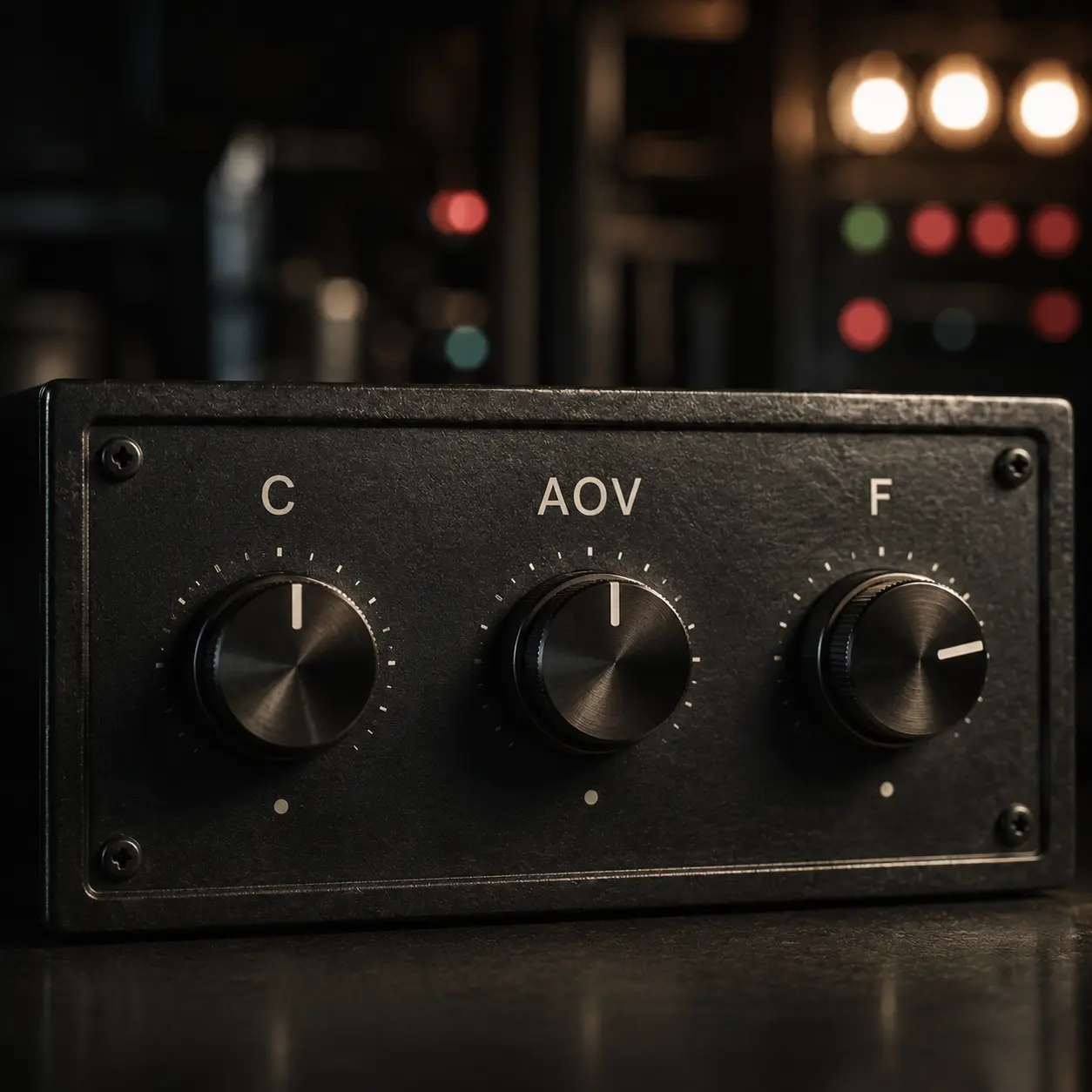
Every business, boiled down to dollars, resolves to one embarrassingly simple equation. Once you see it, you genuinely cannot unsee it — and it explains why some businesses grow steadily while others burn cash on ads and stay flat.
Traffic, Conversion Rate, Average Order Value, Frequency
Quick correction before we go further, because it trips people up constantly: the C in "C × AOV × F" stands for conversion rate, not "customers." It's the percentage of people who see your offer and actually buy — a completely different number from how many customers you have.
Breaking down each lever
Multiply the whole thing by Traffic — the number of people who see your business at all — and you've got the complete revenue equation used across retail and e-commerce: Revenue = Traffic × Conversion Rate × AOV × Frequency.
Running the math
Here's a simple, purely illustrative example — not a real client's numbers, just the mechanics: a business gets 100,000 website visitors, converts 1% of them, and the average order is $100 with each customer buying once. That's 100,000 × 1% × 1 × $100 = $100,000 in revenue. Nudge the conversion rate to 1.5%, or get the average customer to buy twice instead of once, and the outcome moves by 50% — without spending a single extra dollar on new traffic.
Why most owners over-invest in the wrong lever
Traffic is the lever everyone reaches for first — more ads, more spend, more reach. It's also usually the most expensive one to pull, and the gains are temporary: stop paying for ads, traffic drops back down. Conversion, AOV, and Frequency are structural. Fix your site's conversion rate once, and it keeps paying off on every visitor after that, paid or organic.
This connects directly to customer lifetime value (CLV), the metric that determines how much you can actually afford to spend acquiring a customer in the first place: CLV = Average Order Value × Purchase Frequency × Customer Lifespan. A more accurate version layers in gross margin: CLV = (AOV × Frequency × Lifespan) × Gross Margin %. Businesses that improve Frequency and AOV aren't just growing revenue this month — they're raising the ceiling on what they can spend to win the next customer.
Which lever to pull, and how
- Improve Traffic: paid search and social (Google Ads, Meta Ads), and organic visibility through local SEO.
- Improve Conversion (C): a faster, clearer website, a sharper offer, and quicker lead follow-up — most conversion is lost in the first five minutes after someone reaches out.
- Improve AOV: bundling, tiered pricing, and upsells at the point of sale — often the single fastest lever to move because it needs zero new customers.
- Improve Frequency (F): retention systems — email, SMS, loyalty follow-up, and simply asking people to come back (see: retention).
None of these levers matter if you don't know your current numbers. That's step one, before any ad spend gets touched.
Want a quick gut-check on whether your ad spend is actually paying for itself?
Frequently Asked Questions
Which lever should I focus on first if I have a limited budget?
Conversion rate and AOV, almost always. Both act on customers you already have — visitors already on your site, callers already on the phone — so improving them costs no new ad spend. Traffic is the lever that requires ongoing cash to move, and the gains disappear the moment you stop paying for it.
How do I find my current conversion rate?
Divide the number of customers or bookings in a period by the number of visitors, calls, or leads in that same period, then multiply by 100. A website's analytics tool (Google Analytics, or your CRM's funnel report) usually tracks this automatically; for phone-heavy businesses, divide booked jobs by total calls received.
Is frequency the same thing as retention rate?
They're related but not identical. Frequency measures how many times the average customer buys in a given period (total orders ÷ total customers). Retention rate measures what percentage of customers from one period are still buying in the next. A business can have high frequency but poor retention if a small group of repeat buyers masks a lot of one-time customers who never return.
Does this formula apply to service businesses, not just e-commerce?
Yes — it just needs relabeling. Traffic becomes calls, form fills, or foot traffic; Conversion becomes the percentage of those who book a job; AOV becomes average job or contract value; Frequency becomes how often a customer rebooks (a furnace tune-up, a dental cleaning, a repeat client). The math is identical whether you're selling t-shirts or servicing HVAC units in Saskatoon.
Sources
- LoyaltyLion / Polaris Growth — The Secret Sauce for Revenue Growth: Frequency, AOV, and Conversion
- Loyally — What C, AOV, and F Mean in eCommerce Metrics
- HubSpot — How to Calculate Customer Lifetime Value (CLV)
- Shopify — Average Order Value: Formula, Benchmarks and Ways to Increase It
Keep reading
- Marketing Is the Most Important Department in Your Business — how perception raises the AOV lever without touching your product.
- What Is an AI Receptionist, Really? — a direct fix for the Conversion (C) lever when calls go unanswered.
- Google Local Services Ads, Explained — a Traffic lever priced per lead instead of per click.